Friday, December 8, 2017

Bugs in your gut and cancer immunotherapy


Hello, hello!  Do I still have any readers?  I took a bit of a long hiatus, but I’m back and hopefully I will be posting more regularly.  And I have some news!  As of a few weeks ago, I am one of the newest cohosts for the immunology podcast “Audiommunity” (www.emmunity.org)!  I am pretty excited to have this opportunity to discuss all the latest innovations in immunology with a team of Harvard-trained immunologists.  Of course, I am not a Harvard-trained immunologist, but I’m hoping I can add some value to the podcast by being willing to ask the “stupid” questions (there are no stupid questions, amirite?).  I am also hoping to use my blog space to distill some of the high-level research we will be discussing into slightly more accessible summaries.  So if you don’t know one single thing about cancer immunology or immunotherapy, I want you to be able to come away from my page with some new knowledge.

So, without further ado… On the latest episode of “Audiommunity” (episode 26- Lies and Magic), we discussed a recent research article that looked at how the human gut microbiome might play a role in how well a patient with metastatic melanoma responds to immune checkpoint blockade therapy (check out the paper here).  Okay, lots of big terms in that last sentence, so let’s break it all down slowly:

"So, Doc, see anything in there?"
First, let’s talk about the microbiome.  The microbiome is a collection of genes from all the microbes (ie bacteria, fungi and viruses) that live in and on us.  As you have probably heard, human beings are absolutely covered, head-to-toe and inside-out, with bacteria.  They are on our skin, in our mouths, and, yes, in our guts.  At one time, it was commonly believed that there are more bacterial cells on and in our bodies than human cells, although the most recent estimates put that number closer to one-to-one (read more here).  Still, that’s a lot of bacteria (something like 30 trillion cells!).  We call these communities of bacteria the human microbiota, or the normal “flora” (or as I like to call it, your “gut garden”, heh).

Metastatic melanoma, or stage IV melanoma, is a truly horrible diagnosis to receive.  It is melanoma (skin cancer) that has spread through the lymph nodes to other areas of the body, most frequently the brain, bones, lungs and liver.  The 5-year survival rate, which is the percentage of patients likely to be alive 5-years after diagnosis, is very low, hovering around 15 to 20% (see stats here).  But recent, exciting developments in cancer treatment are beginning to improve those odds, for melanoma and other cancers.  These new treatments are called immune checkpoint blockade, or simply immunotherapy.

Seems legit.
Cancer cells and tumors are very tricky things.  Since they are just our own cells, gone wild, they can hold up signs that tell the cells of your immune system not to attack.  Normally, this is a mechanism that healthy cells use to prevent things like autoimmune reactions or to ramp down an immune response after an infection has been cleared. But when used by cancer cells, this trick becomes a dangerous weapon in a tumor’s arsenal.  
The way this works is the cancer cells express proteins on their surface that bind to proteins on the surface of things like T cells, for example, and these binding events cause the T cells to “shut down”. One of the proteins that these cancers can express is called PD-L1 (for “Programmed cell death ligand-1), and this binds to a protein called PD-1 (“Programmed cell death-1) on the surface of T cells (click here for a brief overview from the American Cancer Society).  
The idea behind immunotherapy is to block this binding event, so that the immune cells can raise the alarm against the cancer and attack it.  Scientists like to refer to this as “taking the brakes off the immune system”.  There are now antibody therapies that can block both PD-L1 and PD-1 (for example, you may have seen TV ads for Merck’s Keytruda®, also called pembrolizumab, a PD-1 inhibitor, and made famous by Jimmy Carter), and these are turning out to be remarkably effective against many different types of cancers (2012 NEJM article).

Top: Tumor expresses PD-L1, binds to PD-1 on T cell, and T cell is shut down.  Bottom: anti-PD-1 antibody binds to PD-1 on T-cell and blocks its interaction with PD-L1 on tumor.  T cells are now able to recognize tumor and attack (and they look pissed).


But despite these advances, sometimes immunotherapies don’t work well in some patients or for some types of cancers, or the improvements don’t last, and no one really understands why.  So in the paper we discussed on Audiommunity this week, the authors set out to try and discover whether the gut bacteria in melanoma patients receiving anti-PD-1 treatments had an effect on how well they responded to the treatments.
 
Outline of the study:
The researchers assembled a group of patients with metastatic melanoma (they started with 112), and they collected blood samples and tumor biopsies, and mouth swabs and stool samples to compare the collections of bacteria in the guts of these patients.  They used a technique called 16S rRNA sequencing to determine which bacteria were present in the samples.  16S rRNA is a gene that all bacteria have (we say that it is “well-conserved”), but it differs just a bit between different species of bacteria, so it can act as a sort of molecular nametag for each of the bugs that are present. The patients then received anti-PD-1 immunotherapy.  And 6 months later, the researchers collected samples again, determined whether patients had any improvement in their disease (whether they responded to treatment), and repeated bacterial sequencing.

Results of the study:
What they found was that patients that had a higher diversity of bacteria in their guts (more species, or different types, of bacteria) did better with the treatment than patients with less diversity.  This isn’t a surprising result, since it is pretty well known that loss of microbial diversity, a condition called dysbiosis, results from, or causes, many types of chronic diseases, including cancer (reviewed here).  They also found that patients with specific types of bacteria had different treatment outcomes.  Patients with higher levels of a genus of bacterium called Faecalibacterium responded better, whereas patients with higher levels of members of the order Bacteroidales did worse.

Left gut: highly diverse, lots of multi-colored "sprinkles" (bacteria). Right gut: less diverse, fewer "sprinkles".

Looking at the data a different way, they found that they could predict which patients responded well to the therapy just by looking at the composition of their gut bacteria.  This is a potentially very useful tool for the clinic, because being able to quickly and easily predict how well a patient will do on a specific type of therapy before even beginning the treatment may save critical time in the course of the cancer.

The researchers also compared the types and numbers of immune cells and markers of immune system activation both around the tumors themselves (the tumor microenvironment), and within the gut.  They found that in general there were higher levels of things like tumor-killing T cells and inflammatory markers in the patients that responded well to treatment, and higher levels of suppressive immune cells in the patients that responded poorly.  However, it is unclear whether the gut bacteria directly led to these particular immune conditions or if this is just an association.

Now this is where the study gets really interesting (in my humble opinion).  They took stool samples from the patients, post-treatment, and transferred them into “germ-free mice”.  These are mice that are born and raised in a sterile environment so that they are not colonized by any microbes; this allows researchers to introduce selected bugs into these mice to study their influence on things like the immune system.  After the transplant the mice now mirrored their human patient counterparts (bacterially speaking).  The mice were then injected with melanoma and given immunotherapy.  The mice that received stool from patients that saw improvement in their disease in the initial study wound up with much smaller tumors and higher levels of tumor-fighting immune cells than the mice that received transplants from the patients who didn’t improve.  To put it more plainly, the bacteria in the poop from patients that had a good response to treatment seemed to help the mice respond well to treatment, too.  Pretty cool, if you ask me!

The take-home message:
The long and short of it is this; specific gut bacteria can affect the way a cancer patient responds to immunotherapy.  What is exciting about this is that you can alter your gut microbiota through diet and exercise, probiotics and antibiotics, and through stool transplants (which are already in use in some diseases like Clostridium difficile infection (CDI), to good effect).  This means that it's possible that just some simple tweaks to the bacterial composition of your gut may make immunotherapy even more effective, and the authors of this study are already designing a clinical trial that combines immunotherapy with microbiome alteration (according to this press release).  However, it is important to be clear that despite these promising results, patients should not try to treat themselves with things like probiotics without the express permission of their doctor (***I am not that kind of "doctor”, and nothing in this article or on my blog should be taken as medical advice!!).

So that's all for now, folks.  Please feel free to send me questions, and check back in about a week for my next summary!

Additional Note: the images featured in this post are my own, hand-drawn, mixed-media creations!


Paper reference: 
V. Gopalakrishnan, C. N. Spencer, L. Nezi, A. Reuben, M. C. Andrews, T. V. Karpinets, P. A. Prieto, D. Vicente, K. Hoffman, S. C. Wei, A. P. Cogdill, L. Zhao, C. W. Hudgens, D. S. Hutchinson, T. Manzo, M. Petaccia de Macedo, T. Cotechini, T. Kumar, W. S. Chen, S. M. Reddy, R. Szczepaniak Sloane, J. Galloway-Pena, H. Jiang, P. L. Chen, E. J. Shpall, K. Rezvani, A. M. Alousi, R. F. Chemaly, S. Shelburne, L. M. Vence, P. C. Okhuysen, V. B. Jensen, A. G. Swennes, F. McAllister, E. Marcelo Riquelme Sanchez, Y. Zhang, E. Le Chatelier, L. Zitvogel, N. Pons, J. L. Austin-Breneman, L. E. Haydu, E. M. Burton, J. M. Gardner, E. Sirmans, J. Hu, A. J. Lazar, T. Tsujikawa, A. Diab, H. Tawbi, I. C. Glitza, W. J. Hwu, S. P. Patel, S. E. Woodman, R. N. Amaria, M. A. Davies, J. E. Gershenwald, P. Hwu, J. E. Lee, J. Zhang, L. M. Coussens, Z. A. Cooper, P. A. Futreal, C. R. Daniel, N. J. Ajami, J. F. Petrosino, M. T. Tetzlaff, P. Sharma, J. P. Allison, R. R. Jenq, J. A. Wargo Gut microbiome modulates response to anti–PD-1 immunotherapy in melanoma patients. Science, 2017 DOI: 10.1126/science.aan4236


Thursday, March 16, 2017

Echoes of the bench in my everyday life

Luggage tag I got from a vendor show.  Free stuff! Yay!
I have been a stay-at-home mom for 264 days, just a little under 9 months, and this is the longest I've been away from a lab in nearly 12 years.  But who's counting?  I am often asked by my friends still on the inside whether or not I miss the lab.  The answer is a complicated one, rooted in practical forward-thinking optimism, but tinged with sappy nostalgia for the thing I spent the entirety of my twenties doing.  Let me try to paint a picture for you of what it feels like to be a former bench jockey who finds herself exiled to Elba suburbia.

The closest I get to a centrifuge these days is the shiny, new, high-efficiency washing machine my landlord installed for us.  Sometimes when I'm in my laundry room sorting grungy, stinky little boy clothes (oh, who are we kidding, my husband is an adult), I close my eyes and listen as the spin cycle revs up, the machine shaking ever so slightly as it cruises past 500 rpms, and I remember.  I remember popping tubes into the centrifuge we called "the spaceship", a galactic-gray, futuristic monstrosity from the seventies.  I had to use all my weight to latch the door.  Then I would push "start" and back way, way up as it got up to speed, howling like a spaceship blasting off (hence the name), wondering all the while if this would be the time it finally failed and threw the rotor at me.

I open my kitchen cabinets to pull ingredients for dinner and suddenly I'm whisked back in time to the stock room at my last job; a walk-in closet of consumables and reagents, a science convenience store, if you will.  The possibilities felt endless standing there inside that room, smelling of LB broth, the freshly cleaned glassware sparkling from it's shelves where it had been neatly put away according to size and category.  A hyper-organized Type A's dream.  Back in the present, I cast a resentful look at my sink full of dishes and remember the carefree joy of placing dishes in a tub near my bench, only for them to disappear and magically reappear hours later, clean and ready to use again.  Maybe I should hire a technician?  No, a housekeeping service.  Well, we don't have the grant money for that anyway. 

Later, after I've served a meal to my family who seemed only moderately impressed with my efforts and presentation, I am reminded of the many bosses, committees and reviewers that have judged my work, detached from the blood, sweat and tears I put into it.  As I did back then, I will swallow my pride, take my critiques, and get back to it again tomorrow.  Of course the one reviewer who was unnecessarily cruel will stick with me for a while ("that Western Blot was disgusting Mommy", or did my son say, "casserole"??...).  I aliquot the leftovers and put them in the 4 degree freezer.

I wield wooden spoons and measuring cups like I once wielded pipets.  I read cookbooks like I once read protocols, mixing and matching steps from several versions to come up with the best possible recipe.  I occasionally explode things in the microwave, so that hasn't changed.  I wear disposable gloves to cut up raw meat at BSL-1 and wonder to myself, "shouldn't I be doing this in the hood?".   

I trade the latest news on childhood obesity and brain development with my children's pediatrician.  We commiserate on the sinking vaccination rates and the latest outbreaks of things like the measles.  We express our amazement at the newest recommendations for preventing peanut allergies (news flash: feed your baby peanut-containing products as early as 6 months- check out a piece I wrote for Scientific American Food Matters Blog for more on this).  It's just like being back in the break room at work.  The only things missing are some snacks pilfered from a random seminar and a good cup of coffee.  Perhaps for my kid's next checkup I'll bring some Dunkins and ask the receptionist to babysit for a few minutes.

I read reviews of a new sippy cup I'm thinking of trying out on my toddler, and see advertisements that scream, "revolutionary design, strongest suction!"  Of course I think, "show me the evidence! Where are the links to the data? And is 'strongest suction' really the best thing, physiologically, for the child?  Perhaps a more moderate suction would be more beneficial to the development of their cheek and tongue muscles.  And this cup is so new, it's barely made it beyond peer-review.  Only 23 citations on Amazon..."

This turkey is precisely 165 deg F (and only a little bit dry).
Perhaps more practically, I clean my bathrooms with ammonia and worry about the development of resistant bacteria.  I use a meat thermometer religiously (and frequently serve dried out, overcooked meat as a result) and worry about E. coli, listeria, and salmonella infections.  I help my kids blow their noses and then immediately scrub my hands, hyper-aware of my fingers and keeping them away from my face.

At the same time, I don't stress out about mopping my floors regularly, knowing that a little household dirt is doing wonders to train my kid's burgeoning immune systems (what an awesome excuse to be a lazy housekeeper!).

My kids and I discuss science and medicine around the dinner table and on long car rides, and I supply answers to questions like, "why is blood red?" and " why is pee yellow?" and even "ewww! why does baby sister have blueberries in her poop?!" (kids are preoccupied with bodily fluids).

In short, science has colored every aspect of my life.  Being a scientist is as much a part of who I am as anything else that describes me is (ex "germaphobic", heh).  I will always be a scientist in the way I act, think and feel, regardless of whether or not I suit up to go to work in a lab everyday.

So, do I miss working in a lab?  Yes, I do.  At least, I miss the idea of it, in the wistful sort of way that you might remember a time in your life that you didn't quite appreciate until it was over.  But the things I learned from working in a lab come with me everyday in my life on the outside.  And maybe, one day, I'll go back (although I've made certain friends promise to slap me if I ever seriously consider it), and bring some lessons I've learned on the outside with me.  But that's a post for another time.  

This is the aforementioned centrifuge, complete with a "Caution" sign that I taped to it warning people that the lid slams shut and will take off your fingers if given the chance.  I am told it has since kicked the bucket.  Rest in peace, spaceship.
UPDATE! An old coworker just sent me this much nicer image of the Spaceship. When I asked her why she happened to have this pic, she said, "I took pics of all the old equipment because no one believed me otherwise...And I documented everything in case I was ever injured...".  Sounds about right (shout out to my dana14 crew!).


Monday, January 9, 2017

DinoMania!


Happy New Year!  This post was meant to go up a lot sooner (like, before Thanksgiving...heh), but well, holidays and kids and business and excuses, etc, etc.  Anyway, without further ado- it's time for DinoMania!
 

When I was a kid, I loved dinosaurs.  ‘Love’ probably isn’t even a strong enough word.  I was infatuated with them.  From the time I was about six years old, I wanted to be a paleontologist when I grew up.  I checked out nearly every dinosaur book in the children’s section of our small town library, and spent many, many weekends with my Dad at the Dinosaur State Park in Rocky Hill.  Of course my favorite place to go was the Yale Peabody Museum in New Haven, where I would wander the Great Hall of Dinosaurs and marvel at the massive brontosaurus skeleton, trying to imagine what it would have been like to stand next to these great and terrible lizards (dinosaur is Latin for “terrible lizard”). 

Fortunately (or unfortunately), when I was around eight years old, Steven Spielberg went right ahead and did the imagining for me with a little movie called “Jurassic Park”, which basically ruined dinosaurs for me forever.  To this day I can’t eat jello without scrutinizing it for a rhythmic jiggle, indicating I’m about to be ambushed by a massive T. rex with a taste for man-flesh.  And let’s not forget that gratuitous doghouse-eating scene from one of the horrifically bad sequels.  Totally unnecessary, Steven. 

Rather than stoke my interest in a particular career path, movies have kind of a history of turning me off of a field.  “Jurassic Park” crushed my paleontology dreams.  “Apollo 13” made me rethink my plans of becoming an astronaut- I didn’t think it was possible to be any more emetophobic until I watched Bill Paxton puke in zero gravity- thanks Ron Howard!  My interest in ancient civilizations?  Destroyed by nightmares after watching “The Mummy” in a hotel room on a rainy vacation to Salem, Massachusetts around Halloween time.  Bad combination.  Weirdly enough, the movie “Outbreak” did not manage to scare me away from virology, and I became a virologist anyway, but I digress. 

The point is, don’t get your career aspirations from movies.  It’s much better (and much more accurate and informative) to stick with books, obviously.  Nice, safe, papery, books.

Cake that took me fifty million years to complete.
In my house it seems that my love of dinosaurs has not skipped a generation, and my four-year-old son owns lots and lots of books about them. We just threw him a dinosaur-themed birthday party a few months ago, and he loves to talk about dinosaurs for hours on end, which isn’t all that unusual for children his age.  In fact my husband and I have a theory that a general fascination with dinosaurs is a normal developmental stage for all mini-humans.  Much like when I was a kid, my son has read through practically the entire dinosaur section of our local library, and anytime we are in the vicinity of our favorite Barnes and Noble we somehow manage to return home with a new tome full of the beasts.  

One book in particular, “PrehistoricPredators”, by Brian Switek, is our all-time favorite and I highly recommend it to anyone who has a dino-loving child at home.  The illustrations are beautiful, the facts plentiful, and the pronunciation key is clutch.  My son’s obsession with this book has spawned his favorite, self-invented game, which he has christened “the dinosaur game”.  The idea is that you take turns going back and forth naming dinosaurs until one person can no longer think of dinosaurs to name.  Sounds easy, but it turns out some four year olds play for keeps.

            Four year old: “Okay, I’ll go first.  Diplodocus.”
            Me: “Ummm, Tyrannosaurus rex”
            Him: “Giganotosaurus”
            Me: “Uh, velociraptor.”
            Him: “Dilophosaurus.”
            Me: “Dilopho…What? Uhhh, umm.  Stega, uh, rapta… don.”
 Him: “Haha! Mommy! ‘Stegaraptadon’ is NOT a dinosaur. You just made that up!    You could’ve said stegasaurus or dimetrodon. Duh, silly! I win. Now I get ice cream!”

Sheesh.  I didn’t realize there was ice cream at stake.  Silly me; ice cream is always at stake when you have a preschooler around.  Guess I should pay more attention during story time.

The mighty Stegaraptadon.  Totally real, I swear.


Part of the collection.


Image from Goodreads.com
Well, speaking of story time, I happened to be browsing the new nonfiction section of the library recently when I stumbled upon an eye-catching title.  “TheTyrannosaur Chronicles: the Biology of the Tyrant Dinosaur” by Dr. David Hone jumped out at me without warning*. And I’m glad it snared me because it is a fantastically interesting read for grown ups that never quite “grew out of” their dinosaur phase.

Dr. Hone has written a comprehensive field guide about everyone’s favorite dinosaurs, the tyrannosaurs, and contains beautiful illustrations and figures by Scott Hartman.  Hone covers the history of the discovery of the large family (yes, family- did you know that more than 30 species of tyrannosaur has been discovered so far?), with the mighty T. rex being named in 1905. Tyrannosaurs first appeared in the Jurassic period, but unlike the massive apex predator depicted in the infamous film, the first tyrannosaurs were small, about the size of a horse.  Over time the general trend was for tyrannosaurs to get bigger, and eventually they did resemble the monster we now think of when we think of T. rex. 

But they may not have looked so much like the scaly reptiles of our time.  It’s generally accepted that birds are the living descendants of dinosaurs, having evolved from some avian theropod ancestor.  Think chickens, not crocodiles.  And man, do chickens creep me out- those ugly feet! Those staring, unblinking eyes!  As far as I’m concerned, the resemblance to the terrible lizards is clear (apologies to my Mother, the crazy chicken lady).  And phylogenetically speaking, there is goodevidence to support this relationship.  Although tyrannosaurs themselves are probably more closely related to crocodiles than the “bird-like” dinosaurs were, it is now believed that they (as well as many other dinosaurs) were covered in a downy plumage, perhaps for insulation and for attracting mates.

A few of my other favorite tyrannosaur facts that I picked up from this book include that they had large air spaces in their skulls and highly developed nasal cavities for smelling.  And much like birds, tyrannosaur bones had pneumatic air sacs that were filled by air from the lungs.  In a section discussing the ecology of tyrannosaurs, it is explained that far from modern imaginings of T. rex battling a triceratops, tyrannosaurs actually battled each other both for sexual dominance and for food (yep, they ate each other sometimes).  And they did far more chewing of their prey than wholesale “gulping”, as suggested by the discovery of pulverized hadrosaur bones in fossilized tyrannosaur droppings.  Most of all, I was fascinated to learn that it is incredibly difficult to determine the sex of a dinosaur from its fossil, or whether a smallish fossil is a juvenile, an outlier, or a new species entirely.  It truly is a remarkable researcher that can be satisfied working with such “bare bones” (pun intended). 

Overall, I enjoyed the book, though at times it got fairly academic and may not be for the casual reader.  But if you loved dinosaurs as a kid and you enjoy some pop-sci nonfiction, check out this book. 

To wrap up this “dino-mania” post, I just want to mention that it was reported recently in Current Biology that a dinosaur tail covered in primitive plumage was discovered, preserved in amber (here’s the link to a Sciencepiece about the article since the article itself is not open access).  The images are beautiful, and although dinosaur-era feathers preserved in amber are nothing new, this is the first time a mummified piece of dinosaur skeleton and tissue has been found along with the feathers.  An actual dinosaur tail.  But before you start freaking out, thinking, “this is exactly how Jurassic Park got started!” (I mean, I didn’t think that or anything…) it turns out that no dino DNA could be recovered from the sample, so we’re still safe.  For now.


*Note that they don’t allow jello or other food in the library, even just to serve as an alarm against imminent dinosaur attack (“No Ms. Librarian, I am not going to eat this jello, I’m just going to stare at it to make sure it doesn’t start to jiggle…”).

Tuesday, October 11, 2016

Dr. Mommy, PhD: Doing Science with Preschoolers


Today, I had the unique opportunity to bring together the two biggest spheres of my life - motherhood and science.  At my son’s preschool, as part of the October curriculum focusing on “community helpers”, I was invited to come talk about being a scientist and to do some science demonstrations with a group of very enthusiastic three and four year olds.  I jumped at the chance.  In fact, I had been preparing for this moment since the day my son was born.  I just couldn’t wait for that seemingly far-off day when I would strut into my kid’s classroom, beakers and Bunsen burners in hand, ready to cultivate the next generation of young scientists.  And I imagined how my son would beam when all the other kids told him how cool his Mom was…okay, okay, so I know I’m not as cool as say, a firefighter or a police officer.  But I thought to myself, “Hey! I have a vanity lab coat buried in a closet somewhere (that’s never been in a lab, of course!).  And I can go buy a pair of safety glasses at Home Depot and have my husband bring home some nitrile gloves.  That’ll look cool, right?”  Right??  I tried on the ensemble for my son and he just rolled his eyes, laughed, and then said, “Mommy, you look like a Doctor but you’re not a real doctor!”  Dear reader, I disowned him.
Not that kind of Dr.

Anyway, for my visit, I came in the aforementioned uniform, which, as predicted, earned many excited squeals and shouts.  My own son may not be impressed but the other kids certainly were, which probably just serves to underline how very far we are now from the medical and science hub that is Boston.  I sat on a teeny, tiny chair that I worried was going to collapse under my weight at any moment, and looked down at a group of eager, adorable, budding scientists ripe for the teaching, sitting in a semi-circle at my feet.  I started by asking the group if anyone could tell me what a scientist does.  Here is a small sampling of the answers:

“A scientist wears glasses and looks at things that nobody cares about, and says ‘Hmmmm, interesting’!” (Alarmingly close to the truth)

“They mix up the chemicals and make them go ‘Boom!!’” (We usually try to avoid the ‘Boom!’)

“They eat ice cream!!” (Well, this scientist sure does.  Lots and lots of it)

So, with that out of the way, I went on to explain that scientists ask questions about the world around us, and that we do it in a very special way.  We talked about the scientific method and practiced saying “hypothesis”, which of course was hilarious since even adults have a hard time saying that word.  We made a hypothesis about what would happen if you put water in the freezer (“You get ice! Duh!”- I may have underestimated these kids).  And we talked about making a prediction about what would happen if you put milk into the freezer, based on what happened to the water (“Milkshakes!!”- I may have overestimated these kids).  With our fresh knowledge of the scientific method, we set out to do a couple of experiments.

Whole milk, food coloring and dish soap.  Eyedropper not necessary, just made the kids feel more like scientists.

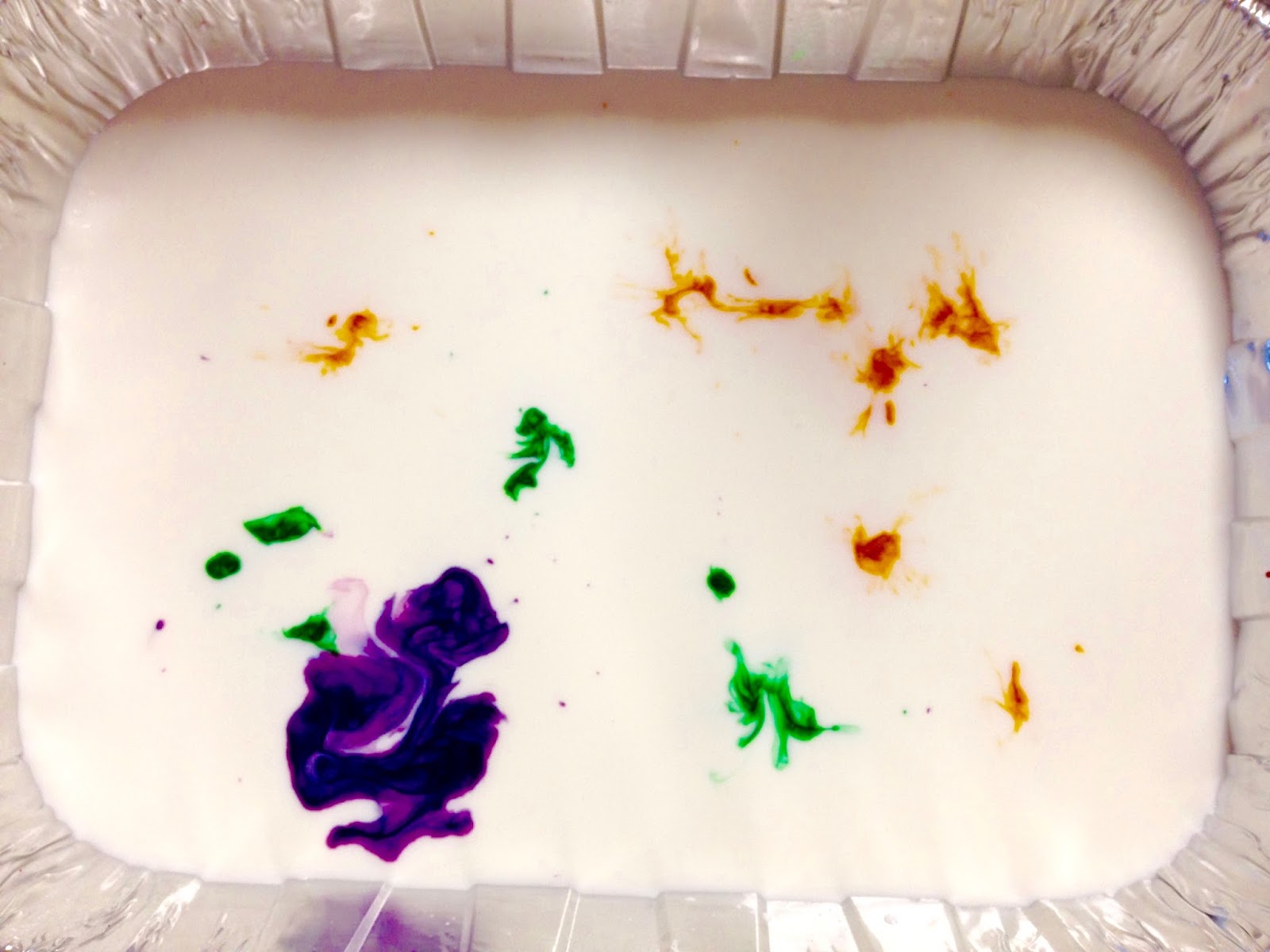
I brought out a casserole tin and poured a quart of whole milk to cover the bottom of the pan (you have to use whole milk for this experiment, the more fat the better).  I pointed out that milk has a lot of healthy fat in it, the kind that makes their brains grow bigger and smarter.  I asked for a volunteer to help me add some food coloring to the milk and we made a hypothesis about what we thought would happen when we added the coloring.  Nearly everyone thought the dye would change the color of the milk.  Then we squirted the dye in and watched in amazement as the drops pooled on the surface of the milk, separate from each other, the rest of the milk remaining white.  
 
We got a little overzealous with the purple dye.

Next, I brought out a bottle of dish soap and asked if anyone helps their Mommies and Daddies do the dishes; I’m sure you won’t be surprised to hear that nearly all of them do!  There were many shouts and cheers about how helpful they were at home.  As a side-note, none of their parents were present for this demonstration.  The teacher rolled her eyes in her teacher-ly way.  My son looked around ready to chime in in the affirmative as well, then made eye contact with me and decided against it.   
We discussed what soap does, that its job is to break down “grease”, which is just another word for fat, and that’s how it cleans the dishes.  We made a hypothesis about what would happen when we added a little dish soap to the milk.  Most guessed that we would make bubbles.  Using an eyedropper, my volunteer dripped dish soap into the pan, and voila!  The food coloring instantly dispersed and swirled into the milk in a beautiful array of colors.  The kids were amazed.  Some asked if they could drink it.  I objected.  That’s going a touch too far for science, even in my book.  So we talked about how before we added the soap, the fat in the milk was holding the dye together, and that when the soap broke down the fat, the dye was able to mix into the milk.

Adding the soap...
Lovely!


Experiment number two was a classic baking soda and vinegar experiment, except I added some drops of food coloring on top of the baking soda to make it more colorful.  I spread some baking soda out onto a tray and asked if anyone knew what baking soda was used for.  Many clearly stated it was “for baking” and I didn’t need to ask if anyone liked cake or cookies, this information was freely volunteered.  It took a minute to calm everyone down when they realized I was not going to be doing a cooking demonstration.  Ah, the sharp sting of disappointment.  When they all caught a whiff of the vinegar, a heated discussion broke out as to the merits of pickles (Eight “yaes”, eleven “ewwwwww! Nays”).  I was pleased they were so savvy in the ways of ingredients.  
 
I strongly recommend doing this experiment on a disposable tray.  Trust me on this one.

This time I got two volunteers to come up and help me out.  The first kid got to use an eyedropper to dribble some vinegar onto the baking soda and we noted that small, fizzy bubbles were made.  We hypothesized that if we used a syringe full of vinegar we would get even more bubbles, so volunteer number two went to town spraying the vinegar into a foaming puddle.  Finally, I put a couple inches of baking soda into a clear plastic cup and filled a measuring cup up with nearly two cups of vinegar.  I was going for broke with the grand finale.  I added some dye to the baking soda and allowed my son, who was sitting very impatiently the entire time, to come and do the honors.  We counted to three and everyone held their breath as we dumped the entire measuring cup of vinegar into the cup of baking soda.  The room erupted in shrieks of excitement as the foam exploded up and over the top of the cup and all over the tray beneath it.  One kid started bellowing, “Volcano! Volcano! Volcaaaaaaanooooooo!” as he danced around the room gleefully.  They LOVED it.  And again, they wanted to drink it. 

What a pretty mess this makes!


Pour quickly but carefully!
 
We cleaned up our experiments (one of the most important parts of doing science, in my opinion) and discussed the reaction between baking soda and vinegar, and how they combine to make carbon dioxide, a gas, and how this reaction is what is responsible for making cakes rise, nice and fluffy.  One girl asked me why I bake pickle-flavor cakes.  Definitely realized I did a poor job explaining acids and bases to this young group and chose to pretend I didn’t hear the question.  I finished up by saying, “I hope that I’ve shown you guys that science is cool and fun!  You can all be scientists, all you need to do is stay curious about your world and ask good questions!” and then I added, “So who wants to be a scientist when they grow up?!”  Amidst a chorus of passionate cries of “Me! Me!” my son announced that he was going to be a real Doctor like his Daddy (again, disowned), and another smart young man stated that he would rather be an accountant (me too, kid, me too).  Volcano boy was still dancing, and shouted proudly, “I’m going to be a volcano when I grow up!!” 

Shine bright, little volcano boy, shine bright.


Saturday, September 3, 2016

Antibiotic resistance got you down? Never fear, paint will save us! …Wait, what??


Considering freshening up your walls?  How about Sterile Steel Blue?  Perhaps Bacteriocidal Beige? Antibacterial Alabaster?

At this point, there isn’t a soul on the planet that hasn’t heard about the growing threat of “super bugs”, previously treatable bacteria that no longer respond to antibiotics.  The recent UK Review on Antimicrobial Resistance predicts our antibiotics will be ineffective by the year 2050.  And 10 million people will die each year of previously minor infections and common medical procedures.  C-sections, hip replacements and transplants will no longer be considered relatively safe and routine.  Depressing.  While I originally planned on writing an article highlighting what I think is a very promising avenue of research into antibiotic alternatives called “bacteriophages” (viruses that kill bacteria), a few days ago I found myself in the glowing grip of a TV commercial I had never seen before.  Let me set the scene for you:
            An attractive woman in her late 30’s, early 40’s, is painting a wall in her house a soothing sage green.  The room is bathed in natural light and the woman is smiling placidly as her brush goes up and down, up and down, in a fluid motion.  The voiceover begins and says, “This is how you apply antibacterial paint”, implying that it is just as easy as applying regular paint.  <End scene>
My brow furrowed.  Did I hear that right?  Antibacterial paint?  A few clicks of the keyboard confirmed that what I had just seen on the TV had actually been announced more than 8 months ago.  The paint company, Sherwin-Williams, is now selling a product called Paint Shield®; a collection of 550 colors of paint infused with a patented antimicrobial compound.  The company is claiming the paint kills 99.9% of bacteria including Staph, E. coli, MRSA, VRE and Enterobacter aerogenes on painted surfaces within two hours of exposure, and continues to kill 90% of bacteria for up to four years as long as the paint surface is intact.  And it will be selling at a ridiculous premium, going for $84.99 a gallon (compared to $29.99 for a regular, old, can of paint at my local hardware store).
I’m not going to take issue with their antibacterial claims.  They have the EPA certification to back it up, indicating that the paint underwent rigorous testing at a third party lab to support those statements.  But the EPA was only assessing the scientific claims at hand; it wasn’t assessing any claims about the usefulness or wisdom of actually using such a product.  And herein lies my problem with it.  Sherwin-Williams’ website says the product was originally developed for hospitals, athletic facilities, schools and daycares, but that it is also an excellent choice for the home, in kitchens and bathrooms and laundry rooms.  What irritated me was when I went digging for more information on Paint Shield® and came across some of the original news releases.  Each article featured some version of the line “new paint may save thousands of lives”, citing the need to combat the growing number of hospital-acquired infections, a quote which at best is yet another example of journalistic exaggeration, and at worst is utter hogwash (see an example here).
While hospital-acquired infections definitely are a big problem, unless patients are routinely licking the walls I don’t think they are at great risk of acquiring an infection from them.  And I could find no research implicating walls in the issue.  In fact, paints (and other surface finishes and fabrics) incorporating antibacterial compounds have been around for quite some time, and large hospitals like Kaiser Permanente actually recommended against their use a few years ago, citing a lack of evidence that they do anything to prevent infections and a lack of safety data concerning long term use. 
In a hospital chock-full of very sick people, the fewer germs, the better.  It is true that bacteria and viruses can sometimes remain infectious on surfaces for days or even weeks.  We call these surfaces “fomites” for their ability to transmit disease, and this is why regular disinfection of hospital floors, walls, and surfaces is already de rigeur.  But the fomites we’re concerned about are ones that we are in regular contact with, things like counter tops, doorknobs, and sinks, which we touch with our hands and then absentmindedly touch our mouths, eyes, and faces.  Even Doctor’s neckties and their classic white coats have been demonstrated to be potentially dangerous vectors of disease (and being married to a Doc, I can say that I do not allow these items to enter my house). 
What I’m trying to say is that claims that painting hospital walls with Paint Shield® will “save thousands of lives” are absolutely overstated. 
That said, in a hospital setting, antimicrobial paint probably couldn’t do much harm, though I have serious doubts hospitals will deem this product useful enough to shell out for its hefty price tag.  What is much more concerning to me, however, is the suggestion that this paint should be used in the home.  A quick search of the patent literature reveals that the patented technology in Paint Shield® is a quaternary ammonium compound (or QAC for short), which they’ve managed to stabilize in the paint.  QACs are nothing new; they have been used for decades in detergents, cleaners and fabric softeners, and are believed to work by disrupting cell membranes.  And they are considered very effective, hence their widespread usage.  But with such widespread usage comes the inevitable: mounting evidence of microbial resistance.
The evidence for resistance is in the presence of genes that enable bacteria to escape the action of antibacterial compounds.  The unnecessary overuse of antimicrobial compounds and chemicals in our homes, which subsequently winds up in the waste run-off in our environment, doesn’t actually manage to kill all bacteria.  Instead, some bacteria see repeated, sub-lethal exposure to the chemicals, which drives the development of resistance genes like the “qac-genes” (reviewed here).  The qac-genes (named for the QAC compounds they function against) encode multi-drug efflux pumps, which contribute to antibacterial resistance by pumping QACs and other germ-fighting compounds out before they have a chance to kill the organism, rendering these chemicals less effective or useless.  Eventually this process results in strains of bacteria that are totally unaffected by these products.  And sometimes this resistance to disinfectants can also result in cross-resistance to antibiotics, making the problem antibiotic resistant infections worse.  This type of resistance is well documented in Staphylococcus aureus for example, one of the organisms Paint Shield® is touted to kill, and the famous cause of nightmare-inducing MRSA infections.
Making this all the more relevant is the very recent announcement by the FDA of a ban on the marketing of antibacterial soaps and other products containing over 19 different compounds, due to a lack of evidence that these products are safe and actually work.  That’s right folks, there is no scientific evidence that antibacterial hand soaps work better than regular hand-washing with soap and water.  Manufacturers of these products will have one year to remove the chemicals from the products or stop marketing them altogether.  And this is great news, since several studies published over the last decade have demonstrated that use of many of these chemicals, Triclosan in particular, not only lack any benefit, but also contribute to growing bacterial resistance (see here and here).
So, in short, will I be running out and buying antibacterial paint for my home?  No thanks.  If the cost alone wasn’t enough to keep me away, the fact that I may actually be making my home and the environment that absorbs my household waste into a breeding ground for resistant bacteria does.  The reality of the coming post-antibiotic age is certainly frightening, but we would do much more to slow it down by limiting our use of products that may contribute to this phenomenon, rather than by trying to encase our families in sterile, little bubbles. 
And for goodness sake, finish your course of antibiotics!